Induction pan types, quality and cooking effectiveness
Issue
- Noisy induction cooking
- Poor induction performance
- Uneven induction cooking
Applies to
- All induction hobs
Resolution
Pans for use on induction hobs come in a variety of types and designs. To work effectively on induction though, at least the base must be made of an iron-based magnetic material. Cast iron is by far the best induction performer but is heavy and expensive, so often, induction pans are made of a lighter metal, such as aluminum. These lighter metal pans wouldn’t ordinarily work on induction, so to ensure they can work, are constructed with composite iron bases.
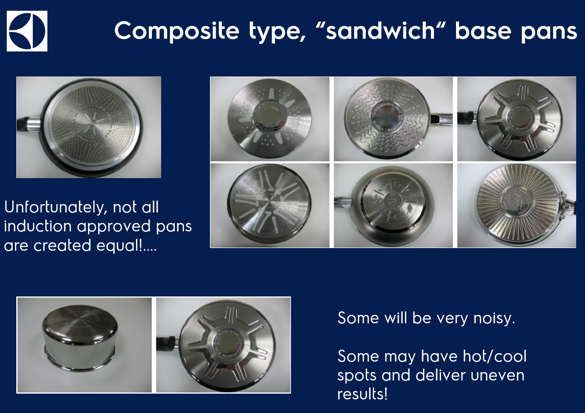
There are many types of these “sandwich” type bases, unfortunately not all perform equally or transfer energy (heat) to the main pan material effectively. Sometimes these bases can prove noisy too as they heat up, due to unequal expansion. Noises can vary from squeals to clicking and cracking/tapping sounds. Magnet test: There is supposedly a test for checking the suitability of induction pans, by using a magnet. Apparently; “If the magnet sticks to the base of the pan, the pan is good for use on induction”.
Unfortunately, although this test is a rough guide to how the pan will work, it is no indicator of how well it will perform!
Was this article helpful?
Related Articles
- Hob displays message L, the hob is locked
- How to Find the PNC Number on an Installed Hob
- Discoloured glass plate / ceramic glass cleaning tips
- How do I connect my electric ceramic or induction cooker to the power supply?
- Induction hob displays error code F or F1
- The induction hob cannot be started after a short circuit
- Hob displays message P
- Hob displays message F
- Hob Not Working: Cannot Activate, No Display, or Interface Not Responding
- Touch Control Induction or Ceramic hob beeps and then switches off
Related Articles
- Hob displays message L, the hob is locked
- How to Find the PNC Number on an Installed Hob
- Discoloured glass plate / ceramic glass cleaning tips
- How do I connect my electric ceramic or induction cooker to the power supply?
- Induction hob displays error code F or F1
- The induction hob cannot be started after a short circuit
- Hob displays message P
- Hob displays message F
- Hob Not Working: Cannot Activate, No Display, or Interface Not Responding
- Touch Control Induction or Ceramic hob beeps and then switches off